
A lightsaber prop was never designed as a product. It was assembled from surplus hardware and then made to glow in post-production — which is why there is no single “correct” saber to copy, and why replica accuracy still splits into tiers today.
The first sabers on screen were not engineered from scratch. They were assembled from whatever was already on a shelf, and the light they appeared to emit was painted on afterwards, frame by frame.
Knowing that changes how you read every replica listing. A hilt is accurate to a specific prop from a specific film — not to “the lightsaber” in general, because that object has never existed in one form.
This page covers how the screen props were actually built, what each visible part originally was, how the glow was faked, and what the accuracy tiers mean when you are buying.
What’s on This Page
- The Three Props Behind Every Saber You See
- Found Parts — the Saber Began as Camera Equipment
- What Each Part Originally Was
- The Blade Did Not Glow — It Was Traced
- From a Wooden Master to Resin Stunt Copies
- “Prop” and “Replica” Are Two Different Markets
- The Replica Accuracy Ladder
- Provenance, and What It Does Not Guarantee
- From a Prop You Watch to a Saber You Own
- Frequently Asked Questions
The Three Props Behind Every Saber You See
Films did not use one lightsaber. They used three kinds of object for the same character: a hero prop for close-ups and beauty shots, a stunt prop built to be swung and dropped, and a bladed version that had to survive contact. Most ignited sabers you actually see mid-duel are stunts, not heroes.
The split exists because the jobs are incompatible. A prop that photographs beautifully in a close-up is usually too delicate and too heavy to swing in a fight scene.
A hero prop is the finished object. It carries the fine detail, the real metal, and the pristine finish — the version photographed for posters and inspected on camera at close range.
A stunt prop is the working copy. It is cast lighter, painted or plated to match, and built to be handled hard. When a character is mid-duel with an igniting blade, what the performer is holding is usually the stunt.
That distinction is the origin of the whole accuracy problem. A replica claiming to copy a character’s saber has to first answer a question it rarely asks: which of the three?
Found Parts — the Saber Began as Camera Equipment
The original hilt was not machined as a lightsaber. It was a vintage camera flashgun — a 1940s press-camera flash unit — sourced from a camera shop and dressed with added parts. The body had the right mass and the right diameter already, which is the entire reason it was chosen.
The set decorator credited with building the first saber was looking for something heavy enough to read as a weapon on camera. He found a flash handle in a box of surplus equipment and recognised the proportions immediately.
Those flash units were not all the same size. They were built in two-cell and three-cell versions, the number referring to how many batteries the tube held. The two share their upper section and their clamp band, and split apart at the middle — so only the lower tube changes between them.
That one fact explains a great deal of the variation between hilts that are otherwise built the same way. A shorter donor body produces a shorter saber, and a builder working from whatever the surplus market offered could not always get the longer version.
The mismatch is still being sold today. The shorter body is common and often offered as though the two were interchangeable, while a build that reproduces a specific screen saber needs the longer one.
That is the pattern the whole prop industry inherited. Rather than design a fictional object from nothing, prop builders of the period dressed real industrial hardware until it read as fictional. The audience supplies the fiction; the object supplies the credibility.
It also explains a detail collectors still chase decades later. Because the base object was a manufactured item with its own part number and its own manufacturing variations, hilts built from it differ from each other in ways nobody designed.
The grips were added, not original. Flat drawer and cabinet runner strips were cut to length and glued on as the ridged handgrip. They came from ordinary furniture hardware, and on screen they read as a deliberate design element.
The remainder of the dressing followed the same logic: a belt ring added so the saber could hang from a costume, and a decorative strip borrowed from a pocket calculator to fill the clamp section.
What Each Part Originally Was
Almost every feature a replica is judged on began as an unrelated industrial part: a camera flash body, cabinet runner grips, a calculator display strip, a belt ring, a grenade body, a jet-engine pipe, a machine-gun booster and a sink fitting. None of them were made for a saber, and that is exactly why a replica has to reproduce them rather than invent them.
Read the list as a donor inventory. Each row is a real component that existed in quantity before the film did.
| Feature on the hilt | What it originally was | Why it was used |
|---|---|---|
| Main body | A 1940s press-camera flashgun | Correct mass and diameter off the shelf |
| Ridged grips | Cabinet and drawer runner strip | Cut to length, glued on, reads as design |
| Clamp strip | A pocket-calculator display window | Bubble texture filled the clamp band |
| Belt ring | A hardware D-ring | Let the saber hang from a costume |
| Emitter | A jet-engine balance pipe | Curved metal lip already looked machined |
| Neck section | A military rifle grenade body | Gave the slimmer saber its tapered profile |
| Detail blocks | A machine-gun booster and a sink fitting | Filled the pommel and mid-body sections |
None of these parts were scarce, and none were precious. They were surplus — available, cheap, and already the right shape.
That is what found part means in prop and replica work: a component sourced from existing hardware rather than fabricated for the piece. It is a term of art, and it is the reason prop accuracy arguments get so specific.
The Blade Did Not Glow — It Was Traced
The glowing blade never existed on set. Performers swung a dull rod or a dowel, and the light was drawn on afterwards by animators who traced the rod frame by frame. The glow is an animation, not a lighting effect.
On camera the rod was deliberately unimpressive. Some versions were spun by a small motor inside the hilt so the surface caught the light at changing angles; a reflective surface treatment was used on others to make the rod flare when hit from a specific direction.
That approach failed at most angles, which is why it was abandoned in favour of drawing the light in. The rod gave the animators a precise, high-contrast shape to follow on every frame.
Animators traced the rod’s position by hand across the footage, then added a bright core, a coloured edge and a soft bloom around it. The wavering, unstable quality the blades have on screen is a by-product of that process rather than an intention.
The blade is the clearest proof that a screen saber is a composite object. What the performer held and what the audience saw are two different things, joined by an animator.
This is why the blades broke constantly. The rods were thin enough to be traced cleanly and cheap enough to be replaced, so they failed regularly during shooting and were simply swapped.
The sound followed the same invented logic. The hum was assembled in a studio from recordings of electrical equipment, not captured from anything resembling a saber — because nothing resembling a saber existed to record.
From a Wooden Master to Resin Stunt Copies
Once a hero prop existed, copies were made from it rather than made again from scratch. A master shape was turned and used to produce moulds, and stunts were cast from those moulds in resin or lighter material so they could take abuse.
It is the same logic as the found parts, one step later. Having found a working object, the production reused it through a copy rather than sourcing a second original.
The master was a solid one-piece shape, turned by hand. That detail decides everything downstream. A one-piece pattern cannot be pressed into a two-part casting flask, so it could not go straight to a metal casting — it had to be surrounded in a flexible mould first, and that mould produced resin copies.
So the chain ran in a specific order: one turned master, one flexible mould taken from it, and a run of cast copies poured from that mould. The copies are the stunts.
The blade rod was set into the mould before the resin was poured. Casting the body around a rod, rather than attaching a blade afterwards, fixes the rod inside the hilt — which is exactly what a stunt needs, since the whole point is that it can be swung without the blade coming loose.
A cast copy loses detail, and that loss is measurable. Moulding and casting soften sharp edges, round off crisp grooves and blur the fine steps that make a machined surface read as machined. Everything that was precisely cut on the hero comes back slightly deflated on the copy.
Cast copies also move. Resin is not dimensionally stable over decades the way metal is, so stunts that survive in collections can be slightly warped or bowed compared to the object they were taken from.
That is why a replica built from a stunt often looks subtly wrong beside one built from a hero, even when both claim the same character.
Some details only exist on the hero. Openings, drilled holes, bare-metal fittings and fine surface steps tend to be present on the machined version and absent on the cast, because casting a through-hole is harder than not casting one.
A replica maker working from photographs of a stunt will faithfully reproduce that absence. The result is accurate to the copy, and inaccurate to the object the copy was taken from.
“Prop” and “Replica” Are Two Different Markets
A prop is an object used to make a film. A replica is a new object made to resemble one. They overlap only in appearance — and the word “stunt” means something different in each world, which is where most confusion starts.
In film production, stunt refers to the durable copy built for action. In the enthusiast saber market, the same word is used for a saber with a lit blade and no sound at all.
Neither usage is wrong. They simply belong to different trades, and a buyer who has read one meaning will misread the other.
The useful test is what powers it. A production stunt exists to be handled during a shoot. A hobby stunt saber is a complete working object that happens to have no audio.
Underneath, both point at the same underlying split: a hero configuration is the complete object, and a stunt configuration is a reduced version of it, chosen for a practical reason.
The Replica Accuracy Ladder
Replica accuracy is not one target but four, and each tier is defined by how close the build gets to a specific original: an unmodified found part, a machined copy of a hero, a cast copy of a stunt, and a generic shape inspired by the films. The tiers are not a quality ranking — they are different objects with different references.
Read the ladder from the top down as increasing distance from the original object.
| Tier | How it is made | What accuracy means |
|---|---|---|
| Original found part | The real industrial component, unmodified | Accuracy is absolute by definition |
| Machined hero copy | Cut from billet to match a hero | Sharp detail, correct mass, correct scale |
| Cast stunt copy | Moulded from a stunt and finished | Correct silhouette, softened detail |
| Generic shape | Designed to look like the films broadly | Reads as a saber; copies no specific object |
The crucial point is that the tier is not the same as the price. A well-made cast copy of a documented stunt can be more historically correct than a beautifully machined hilt based on a film the maker never measured.
What the ladder actually does is let you ask a better question than “is this accurate”. The useful version is: accurate to what, and how do you know?
Provenance, and What It Does Not Guarantee
Provenance is evidence of where a design came from, and it is the strongest signal a replica can carry. It is not the same thing as accuracy: a build can be properly licensed, carefully derived and still miss the original geometry, because a licence establishes permission rather than correctness.
The practical difference shows up in how a maker describes the reference. A build derived from measurement of a physical prop carries different information from one derived from photographs of a finished replica.
Ask what the design was measured against. A physical object, archival material, or another replica — each answer sets a different ceiling on how close the result can get.
Where a maker documents measurements, openness is the useful signal. Stated diameters, counts and thread sizes can be checked against known figures for the original; a listing with only adjectives cannot be checked at all.
Expect legitimate variation rather than a single truth. Because films used several props per character and those props differed from each other, two accurate replicas of the same character can differ and both be defensible.
From a Prop You Watch to a Saber You Own
For a buyer rather than a collector, the point of prop history is narrower: it tells you which features are inherited from a real object and therefore worth insisting on, and which are invention. A machined body, a ridged grip section, a raised clamp band and a centred emitter are inheritance. Blade colour and sound design are invention.
Both matter, but only the first group has a correct answer you can check.
For the film-by-film detail, the site covers the five signals that separate replica tiers, the prop history of a prequel-era hilt, and why a curved prop is the hardest to reproduce.
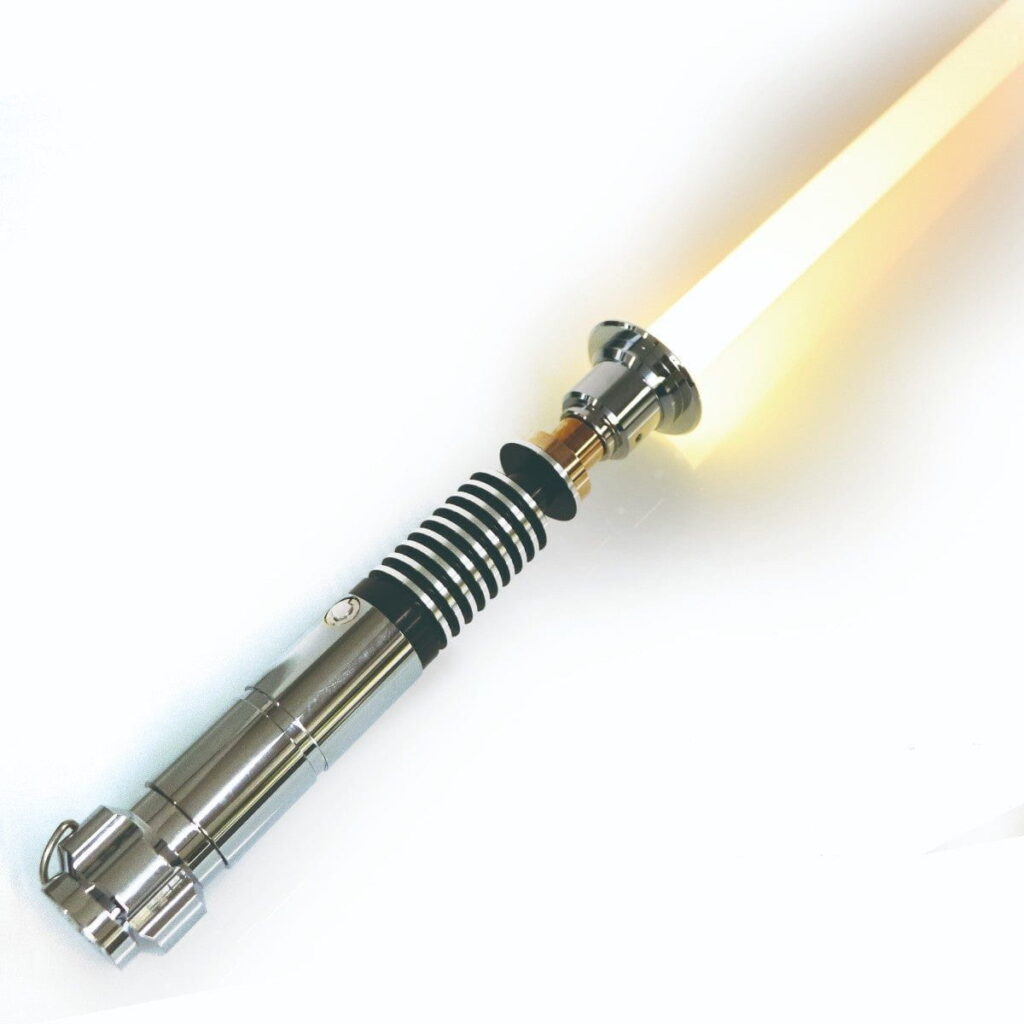
That is the honest use of prop history as a buyer. It does not tell you which saber to want. It tells you which parts of the object in front of you are carrying forward something real.
Luke Lightsaber
Character Lightsabers / Luke Skywalker Lightsaber
Frequently Asked Questions
Q1: What is a lightsaber prop?
A: The physical object used to make a film, as opposed to a replica made afterwards. The originals were assembled from surplus hardware and factory parts rather than designed as sabers, and the glowing blade was added in post-production rather than emitted by the prop.
Q2: What was the original lightsaber prop made from?
A: A vintage 1940s press-camera flashgun, sourced from a camera shop because it already had the right mass and diameter. Cabinet runner strips were glued on as grips, and a calculator display window, a belt ring and a decorative D-ring completed the dressing.
Q3: What is the difference between a hero prop and a stunt prop?
A: A hero is the finished object used for close-ups and beauty shots, with fine detail and real metal. A stunt is a lighter copy cast from it, built to be swung and dropped. Most sabers seen igniting mid-duel on screen are stunts.
Q4: How was the lightsaber glow made in the original films?
A: It was drawn on. Performers swung a dull rod or dowel, and post-production animators traced the rod by hand on every frame, then added a bright core, a coloured edge and a soft bloom. The blade never emitted light on set.
Q5: Why did the lightsaber blades break during filming?
A: Because the rods were deliberately thin and cheap. They had to give the animators a clean, high-contrast shape to trace, and they had to be replaceable, so they were treated as a consumable and swapped whenever they failed.
Q6: What does “stunt saber” mean in the lightsaber hobby?
A: Something different from the film meaning. In the production industry a stunt is a durable copy built for action scenes. In the enthusiast market it usually means a saber with a lit blade and no sound, or an empty hilt.
Q7: Are replica lightsabers based on hero props or stunt props?
A: Often on stunts, and sometimes without the maker realising it. Cast copies soften sharp edges and lose details like through-holes, so a replica derived from a stunt can be accurate to the copy and inaccurate to the original object.
Q8: What are found parts on a lightsaber prop?
A: Components sourced from existing hardware rather than fabricated for the piece. The original sabers used a flashgun body, cabinet runner grips, a calculator window, a jet-engine balance pipe, a grenade body and a sink fitting, with none made for a saber.
Q9: Do original lightsaber props ever come up for sale?
A: Yes. Screen-used sabers surface at auction houses periodically and are catalogued with their component list, which is the same donor inventory described above — a flash body, ribbed grips, a clamp strip and a belt ring. Auction listings are the most detailed public record of how a given original was put together.
Q10: Why is a screen-accurate lightsaber prop so expensive?
A: Because accuracy has to be researched rather than guessed. Reaching a specific original means measuring a physical prop or archival material, reproducing features that only exist on the hero, and machining the found parts that a generic hilt would simply approximate.
Related reading on this site: the three systems every saber is built from, hilt anatomy and choke points, and what a wearable saber needs.