
A “real” lightsaber is not one thing. The word covers four separate claims — physically real, functionally real, visually real, and canonically real — and while the first three can all be true at once, the fourth cannot be true at all.
Most debates about “real lightsabers” go nowhere because the two sides are answering different questions. One is asking whether a metal object in your hand counts as real. The other is asking whether a plasma blade as shown in the films exists.
Both are reasonable questions. They just have different tests.
This page separates them. It sets out the four senses of the word, then gives the engineering markers that settle the three that can be settled — the hilt material, the blade material, the light source, the motion sensor, and the battery — and briefly explains why the fourth sense is a hard no rather than a maybe.
What’s on This Page
- The Four Things “Real” Can Mean
- The Metal Test — What the Hilt Is Machined From
- The Blade Test — Polycarbonate vs Plastic
- The Light Test — LED, and Why It Is Not a Laser
- The Motion Test — Sensors, Not Switches
- The Power Test — Removable Lithium Cells
- What Stays Unreal
- The Whole Test on One Page
- Frequently Asked Questions
The Four Things “Real” Can Mean
“Real” in the lightsaber hobby means one of four things: physically real (made of metal, not moulded plastic), functionally real (it can be swung and used), visually real (it reproduces the film look), or canonically real (it works as a plasma blade). The first three are engineering questions with yes answers. The fourth one isn’t.
Sorting a conversation into these four buckets usually ends the argument, because each bucket has its own evidence.
The physical claim is about materials. A toy blade is moulded polymer on a plastic handle; a real one is a machined aluminium hilt with a polycarbonate tube. That’s checkable by hand.
The functional claim is about use. A real saber can be spun, carried, and duelled with without the blade folding away or the handle splitting.
The visual claim is about light. Films show a blade that ignites from the hilt and rolls outward — an effect only a blade lit along its whole length reproduces.
The canonical claim is about physics, and it is the one with a flat answer. It is covered at the end of this page.
| Sense of “real” | What it asks | What settles it | True? |
|---|---|---|---|
| Physically real | Is this a metal object? | Hilt material, blade material | Yes |
| Functionally real | Can it be used, not just displayed? | Construction, retention, electronics | Yes |
| Visually real | Does it look like the films? | Light source and placement | Yes |
| Canonically real | Is it a plasma blade? | Physics, not engineering | No |
The Metal Test — What the Hilt Is Machined From
A real lightsaber hilt is machined from aluminium bar stock, usually a 6000-series alloy in a T6 temper, with a wall thickness of roughly 2.5 mm or more. A toy hilt is injection-moulded plastic, which is why it feels light, warms to the hand instead of staying cool, and cannot hold a thread.
The hilt is the first and easiest test, because it is the part you hold.
Machined aluminium has three properties moulded plastic cannot copy. It is dense enough to give the saber real weight, it conducts heat so it feels cool at first contact, and it can be cut with threads fine enough to screw sections together and hold them.
Those threads matter more than they sound. A hilt that unscrews into sections — emitter, body, pommel — is how blades, battery packs and electronics get swapped. Plastic cannot hold that kind of thread, so a plastic saber is sealed.
Anodising is the finish you will see on almost every metal hilt. It is an oxide layer grown on the aluminium itself, not paint, so it colours the metal without covering it and resists wear far better than a coating.
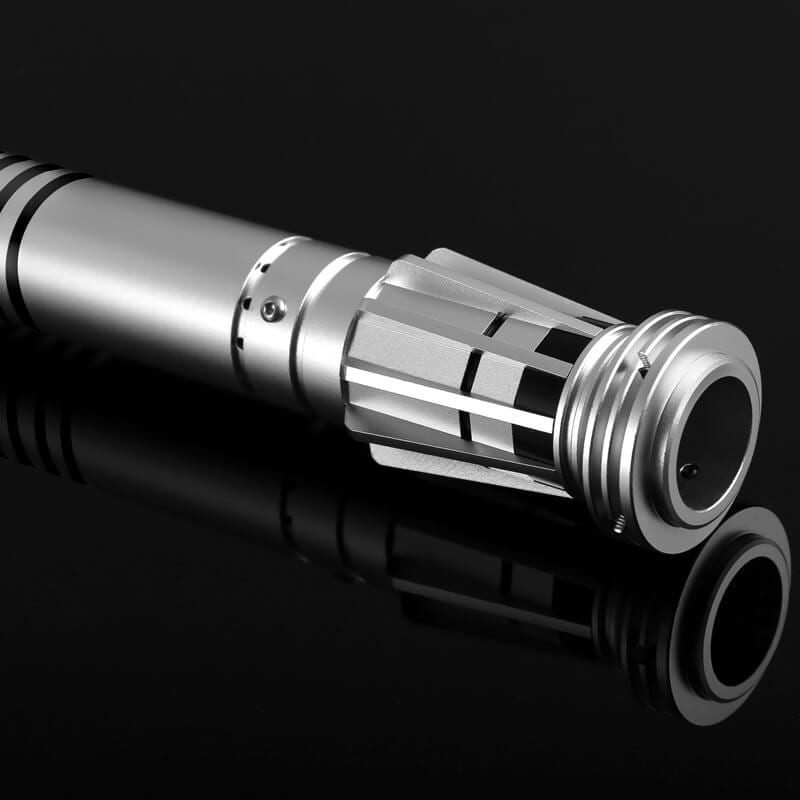
The tell is tooling, not colour. Look for crisp shoulder steps, a knurled band, or a threaded collar where the section joins. Those are cut features. A toy either omits them or fakes them as smooth decoration.
The Blade Test — Polycarbonate vs Plastic
A real saber blade is a polycarbonate tube, normally 1 inch (25.4 mm) in outer diameter, with a wall between about 1.5 mm and 3 mm. Polycarbonate bends under impact and springs back; the plastic used on toys dents, creases, and eventually cracks.
The blade is where the physical claim and the functional claim meet.
Polycarbonate is the same family of polymer used for impact-rated windows. That is why the standard description of a real blade is that it “bends but doesn’t shatter” — it absorbs a hit by flexing, then returns to straight.
The wall thickness sets what the blade can take. A thin wall passes more light and looks brighter; a thick wall absorbs contact. That trade-off is the whole reason blades come in grades rather than one spec.
| Blade property | Real saber | Toy saber |
|---|---|---|
| Material | Polycarbonate tube | Moulded plastic, often telescoping |
| Outer diameter | 1 in / 25.4 mm standard | Not standardised |
| Wall | 1.5–3 mm, graded | Thin, unreinforced |
| Under impact | Flexes and recovers | Dents, creases, cracks |
| Replaceable | Yes — blade unscrews from hilt | No — sealed into the mechanism |
Replaceability is the quiet giveaway. If the blade cannot come off the hilt, the saber was not built to be used with one that can wear out.
The Light Test — LED, and Why It Is Not a Laser
Every real saber sold in the hobby lights the blade with LEDs, in one of two places: a single high-power LED in the hilt shining up a hollow tube, or a strip of individually addressable LEDs running the full length inside the blade. Neither is a laser.
This is the test most often got wrong, because “laser sword” survives as branding even when nothing laser-like is involved.
The LED placement decides how the blade looks. An in-hilt LED gives an even, bright glow and leaves the tube empty and tough. A strip inside the blade gives the rolling ignition and retraction the films show, at the cost of putting electronics where the impacts land.
Both are ordinary light sources. A blade bright enough to light a room is still an LED behind diffusing material.
| Light source | Where it sits | What you see |
|---|---|---|
| In-hilt LED (RGB baselit) | Single module in the handle | Even glow, hollow blade, toughest |
| In-blade LED strip (Neopixel) | Full length inside the tube | Rolling ignition, tip effects, film look |
| Actual laser | Not sold as a toy | Eye and burn hazard; not this category |
So the light test is simple. If the blade lights evenly from a source in the handle, it is an in-hilt LED. If it ignites with a travelling band of light, it is a pixel strip. If a listing calls it a laser, check what actually lights it.
The Motion Test — Sensors, Not Switches
A real saber tracks movement with a solid-state accelerometer or gyroscope built into its board, so the swing sound and the clash effect follow the motion. A toy uses a simple tilt or contact switch, which fires on any movement and lags behind it.
Sound is where a real saber separates itself from a toy even when both light up correctly.
The difference is what the board is measuring. A motion sensor reads acceleration and rotation many times a second; a switch only knows open or closed. One follows the swing, the other reacts to it.
That is why a real saber’s hum rises as you move and a toy’s effect fires a beat late, or on a shake that never happened.
Smooth-swing behaviour is the visible proof. If the sound glides with the blade through a slow arc, there is a sensor in there doing the work.
The Power Test — Removable Lithium Cells
A real saber runs on a removable lithium-ion cell — most commonly the 18650 size — in a holder you can open, so a worn battery is replaced rather than the whole saber. A toy typically uses sealed disposable cells or a built-in pack.
Power is the least glamorous test and one of the most useful, because it decides whether the saber ages well.
An 18650 is a high-drain, rechargeable cell about 18 mm across and 65 mm long. Sabers use it because the LED load is heavy and sustained; the cell has to deliver current, not just capacity.
A removable holder means the saber keeps working for years. The cell is the part that wears out first, and on a real saber it is a service item, not an expiry date for the product.
On a toy, the same wear means a dead object.
What Stays Unreal
A blade of contained plasma does not exist and is not close to existing. Holding a plasma column in a one-handed hilt requires power density and magnetic containment far beyond any portable technology, which is why the canonical sense of “real” is the one answer that stays no.
This is not a limitation of current components. It is the physics.
The numbers are the reason. A blade that cuts the way the films show needs a sustained, contained energy column, and its containment would have to hold against the blade’s own pressure. Nothing that fits in a hand comes close.
So the honest split is clean. Everything on this page before this section describes objects you can buy, hold, and use. This section describes one you cannot.
The Whole Test on One Page
A saber is “real” in the three practical senses when five things are true at once: a machined aluminium hilt, a polycarbonate blade that comes off, an LED light source, a solid-state motion sensor, and a removable lithium cell.
Those five markers are what separate a metal, usable, film-look saber from a toy, and none of them requires you to take anyone’s word for it.
The test runs in one direction. Every check is something you can confirm yourself — material by hand, blade by unscrewing it, light and sound by turning it on, the battery by opening the holder.
Read the bars as effort, not quality. The first two checks take seconds. The last two take a turn of the wrist. None of them needs a spec sheet.
For the deeper engineering behind each marker, the site covers collector-grade hilt construction, how screen accuracy is judged, and the two light-source architectures in full.
Frequently Asked Questions
Q1: Are there real lightsabers?
A: Real in the sense of a metal hilt, a polycarbonate blade, an LED light source and working sound — yes, thousands exist and they are sold openly.
Real in the sense of a plasma blade like the films, no. That one does not exist and is not close.
Q2: How can you tell if a lightsaber is real or a toy?
A: Pick it up and unscrew it. A real saber has a machined aluminium hilt that feels cool and dense, and the blade comes off. A toy is plastic and sealed, with the blade fixed into a folding mechanism.
Q3: What is a real lightsaber made of?
A: A machined aluminium hilt, usually a 6000-series alloy in a T6 temper; a polycarbonate blade tube around 1 inch across; an LED or LED strip as the light source; a small circuit board with a motion sensor; and a removable lithium-ion cell, most often the 18650 size.
Q4: Is a lightsaber a real weapon?
A: No. The blade is an LED behind diffusing material, so it emits visible light, not a cutting beam. A real saber can be swung and duelled with, but it is a sports and display object, not a weapon.
Q5: Are neopixel lightsabers real?
A: They are real in the physical, functional and visual senses. A Neopixel saber uses a strip of individually addressable LEDs inside the blade, which is what produces the rolling ignition the films show. It is still an LED blade, not a plasma one.
Q6: Why is a real lightsaber heavier than a toy?
A: Because the hilt is solid aluminium rather than hollow moulded plastic, and the internals — board, speaker, sensor, and a large lithium cell — sit inside it. The weight is a by-product of the materials, not something added for effect.
Q7: Do real lightsabers have a laser in them?
A: No. “Laser” survives as branding, but the blade is lit by LEDs. Genuine laser-based sabers exist as one-off builds, use real laser diodes, and carry eye and burn warnings. They are not what the hobby sells.
Q8: Can a real lightsaber blade be replaced?
A: On most of them, yes. The blade screws into the emitter and is held by a retention screw, so a scuffed or cracked tube can be swapped without replacing the saber. This is also one of the fastest ways to tell a real saber from a toy.
Q9: What battery does a real lightsaber use?
A: A removable lithium-ion cell, most commonly the 18650 size, held in a compartment you can open. That makes the cell a replaceable part instead of a limit on how long the saber lasts.
Q10: Why do real lightsabers cost more than toys?
A: The cost is in the materials and the parts count. Machined aluminium, a polycarbonate blade, an LED array, a motion board, a speaker and a rechargeable cell are all real components, and several of them are precision parts. A toy replaces most of that with moulded plastic and a simple switch.
Related reading on this site: the anatomy of the three systems, the hilt anatomy reference, and the full blade reference.