
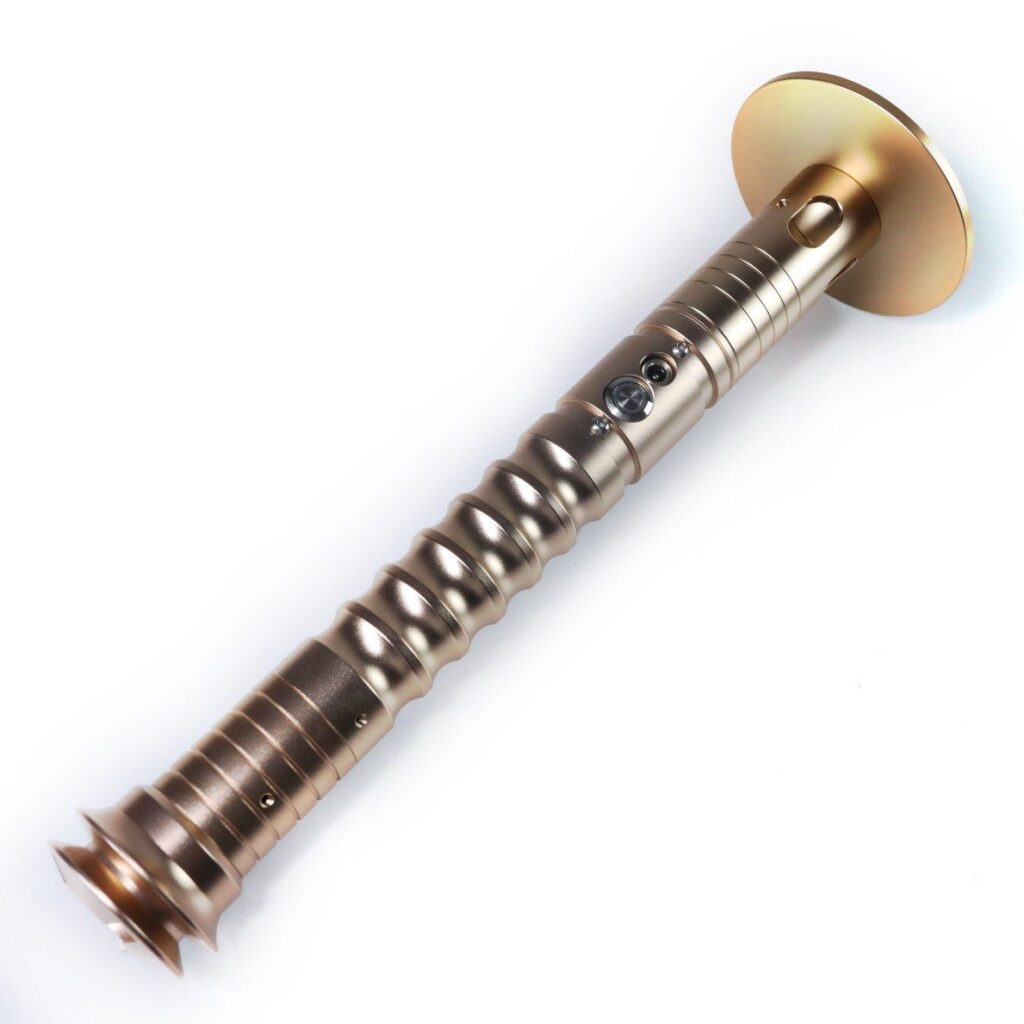
A katana lightsaber is a saber whose katana influence lives entirely in the hilt: an extended two-handed grip, a tsuba-style hand guard, and a windowed emitter. The blade above it is still the standard round tube, so what you are choosing is a grip shape and a balance point, not a different kind of blade.
That distinction matters more than it sounds. Most people who go looking for a katana saber expect the sword part to be in the blade, and buy on that assumption.
It is not, on this saber. It runs the same one-inch round tube as everything else in the range, and the katana styling sits entirely in the handle. Flat katana-profile blades do exist as a separate option on some other sabers, but they need a hilt built to take one rather than a standard round socket.
This page covers what actually changes when a hilt is built katana-style, how the longer grip and the guard alter handling, why the blade is not the katana part, and what to check before you buy one.
What’s on This Page
- What Makes a Saber a Katana Saber
- The Extended Hilt and Two-Handed Grip
- The Tsuba and What a Guard Does on a Saber
- The Windowed Emitter
- Grip Texture: Ribbed and Wrapped
- Why the Blade Is Not the Katana Part
- Balance, Leverage, and Dueling
- Frequently Asked Questions
What Makes a Saber a Katana Saber
A katana lightsaber is defined by its hilt, not its blade. The long grip, the guard, and the emitter shape are what carry the katana reference; the blade is a standard round tube lit the same way as any other.
The reason is mechanical before it is stylistic. A real katana blade is flat in cross-section, curved along its length, and sharp on one edge only.
A standard lightsaber emitter is a circular socket that accepts a circular tube, and a flat blade has no face to seat against one.
So a round-socket saber can copy the katana’s handle and guard, and it cannot copy its blade. A saber built this way is making that compromise, and knowing it up front saves you from buying on a false premise.
What you actually get is a saber that handles differently. The longer grip changes how you hold it, and the guard changes where your hand can go. Those are real differences you feel on the first swing.
| Feature | Katana saber | Standard saber |
|---|---|---|
| Hilt length | Extended, built for two hands | Shorter, often one hand and a half |
| Hand guard | Tsuba-style plate at the emitter | Usually none, or a low ring |
| Grip surface | Ribbed or wrapped, longer bearing area | Shorter, sometimes knurled |
| Emitter | Often windowed, with light spill at the base | Usually a plain solid shroud |
| Blade | Standard round tube | Standard round tube |
| Blade swap | Interchangeable with other round blades | Same |
Read the blade row twice. A round-socket katana saber takes the same blades as any other saber of that socket size, and the katana styling adds nothing above the emitter.
The Extended Hilt and Two-Handed Grip
The hilt on a katana saber is longer than standard, at 34 cm on this one, and it is built so both hands can sit on the grip. A longer hilt moves the balance point and changes how much leverage you get out of the lower hand.
Hilt length is the single biggest difference between this and a standard saber, and you notice it immediately.
The shaded bands mark where each grip position falls, not hands. On the short hilt the two fall close together, so there is little room for the rear position to act as a lever. Widening that gap is the whole reason the hilt on this saber is longer than standard.
A short hilt encourages a one-handed or one-and-a-half grip. Both hands nearly touch, and the lower hand has little room to work as a lever. This hilt measures 34 cm, well past the length a one-handed grip needs.
Length separates the hands. On an extended hilt the upper hand sits close to the emitter and steers, while the lower hand sits well back and drives. That separation is what produces fast tip response without a heavy swing.
It also changes the feel of the weight. A long hilt moves mass behind your hands rather than in front of them, so a saber that measures heavy can still point quickly, because the rear hand is close to the pivot.
What it costs is reach in the other sense. A longer hilt means less of the total length is blade, so for a given overall length you are trading blade for handle.
The practical question is which end you want the leverage on. Two-handed techniques and choreography favour the long grip; tight, fast single-hand work favours a shorter one.
The Tsuba and What a Guard Does on a Saber
A tsuba is the plate between the handle and the blade on a Japanese sword, and on a saber it does the same job: it stops the hand sliding forward onto the emitter and blocks a strike from running down the blade into the fingers.
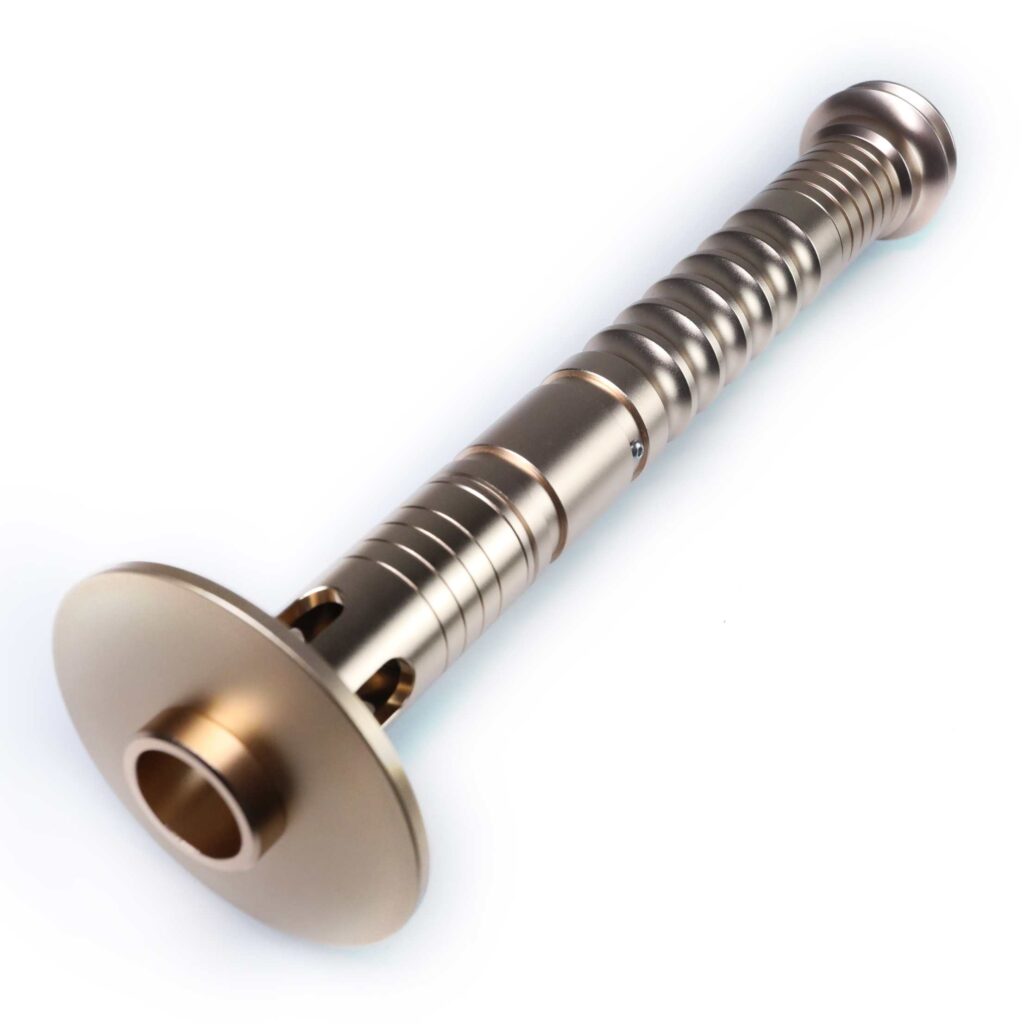
On a real katana the tsuba sits at the point where the grip meets the blade, and it is there for the same two reasons a saber needs one.
The first job is keeping your hand off the hot part. A saber emitter gets warm, and on a long two-handed grip the forward hand has further to slide before it runs out of handle.
A guard shortens that slide to nothing.
The second job is deflecting. When a blade slides down yours toward your hand, a guard gives it a surface to stop against instead of fingers.
A tsuba and a crossguard get confused constantly, and they are not the same design.
| Tsuba-style guard | Crossguard | |
|---|---|---|
| Shape | A plate roughly perpendicular to the hilt | Two short side emitters branching off the hilt |
| Purpose | Protect the hand, stop a slide | Vent excess energy, and protect the hand |
| Lights up | No, it is a solid plate | Yes, the side branches emit |
| Effect on handling | Minimal; it is thin and near the pivot | Adds bulk and width at the top of the hilt |
| Where it comes from | Japanese sword furniture | A distinct saber design of its own |
A tsuba stays dark because it is not a light source. That is the whole point of the look: a dark plate interrupting the glow at the base of the blade.
The Windowed Emitter
A windowed emitter has cut-outs in the shroud around the base of the blade, so light from the emitter spills sideways near the hilt instead of being hidden by a solid tube.
Most sabers use a solid shroud. It holds the blade, hides the base of the tube, and keeps the light column clean from the emitter up.
A windowed emitter trades that cleanliness for a lit base. Light escapes through the openings and washes the top of the hilt, which is the effect the katana-style hilts are built around.
The trade-off is that the base of the blade is now visible. Where a solid shroud hides the point the blade meets the hilt, a windowed one shows it, including the small gaps and shadows that a solid shroud would have concealed.
On a well-built saber that reads as detail. On a lesser one it exposes the fit.
Windows also mean the emitter is more open to dust and lint, because the openings are real holes. A minor point, and one that matters if the saber lives on a shelf for long stretches.
Grip Texture: Ribbed and Wrapped
The grip on a katana saber is usually ribbed or wrapped over a longer bearing area than a standard hilt. Ribbing and wrapping both exist to stop the hand sliding, and they differ in how they feel and how they wear.
A two-handed grip slides under load more than a one-handed one, simply because the rear hand is doing more work and is further from the point of contact.
Texture is the answer to that, and there are two common ways to get it.
Ribbing is machined into the hilt itself. The handle is turned with ridges, usually as a smooth wave rather than a sharp step, so the hand has something to close on without the edges cutting in.
Ribbed grips are durable because the texture is the metal. They also tend to feel more like a tool than a weapon.
A wrap is a separate material applied over the handle. Traditional sword grips are wrapped in cord, and saber grips imitate that with leather or a synthetic strap.
A wrap gives a warmer feel and better grip when the hand is damp. It also wears, and a wrap that has loosened will turn under the hand, which is worse than no texture at all.
On a long hilt the difference is concentrated in the rear hand. That hand moves least and loads most, so it is where the grip material is tested first.
Why the Blade Is Not the Katana Part
A real katana blade is flat, curved, and single-edged. A saber blade is a round tube that glows on all sides. A round tube carries no edge and no curve, so a saber built this way keeps the round blade and puts all of the katana reference into the hilt.
A katana blade is shaped the way it is because the shape is what does the cutting. A round glowing tube has no edge to orient, so there is nothing for that shape to do, and a flat blade needs an emitter built to seat one.
Most buyers get this backwards, so it is worth being blunt about it.
The curved geometry of a katana is not decoration. The curve is what lets a draw-cut slice rather than chop, and the flat cross-section is what gives the edge its geometry.
A round glowing tube has no edge to orient and no curve to draw. A flat profile is possible, and some sabers offer one, but it takes a matching emitter rather than the round socket this saber uses.
So the katana saber is honest about what it is copying. It copies the handle, the guard, and the proportions, and it leaves the blade alone.
The upside is that blades stay interchangeable. Because the socket is standard, a katana saber takes the same round blades as any other saber of the same size, so blade length and grade are still your choice.
A word of caution if you have seen flat saber blades sold as katana blades: those are their own product with their own hilt, not a blade you fit to a standard round emitter.
Balance, Leverage, and Dueling
The extended hilt on a katana saber is a leverage change. It puts more of the mass behind your hands, which makes the tip respond faster but also changes where the saber wants to sit in your grip.
A saber balances somewhere along its length, and where it balances decides how it behaves in motion.
Move the balance point closer to your hands and the tip becomes easier to move and easier to stop. Move it away and the tip carries momentum that resists both.
The long hilt does that first thing. Because the handle is where your hands are, a hilt that takes up more of the total length pulls the balance point back toward the pivot.
The practical result is a saber that feels controlled in two hands and slightly awkward in one, since a single hand has to manage a longer lever on its own.
For choreography and two-handed forms this is the point of the design, and the reason extended hilts get chosen for it.
For hard contact, the guard and the long grip both help, because the forward hand has real protection and the rear hand has room to absorb a stop. Where the design gives less is in tight, fast single-hand work, where the extra hilt length is dead weight behind your hand.
Frequently Asked Questions
Q1: What is a katana lightsaber?
A: It is a lightsaber whose hilt is styled after a Japanese sword: a longer two-handed grip, a tsuba-style hand guard, and often a windowed emitter. The blade above it is a standard round tube. The katana influence is in the handle and guard, not in the blade.
Q2: Does a katana lightsaber have a curved blade?
A: Not this one. It takes a straight round tube like any other saber of the same socket size. Curved blades do not exist in any form, and flat katana-profile blades do exist but run on their own hilts. On a saber built around a round emitter, the katana reference is carried by the hilt.
Q3: What is a tsuba on a lightsaber?
A: It is the plate between the grip and the emitter, borrowed from Japanese sword furniture. On a saber it stops your forward hand sliding up onto the emitter and gives an incoming blade a surface to stop against instead of your fingers. It is a solid plate and does not light up.
Q4: Is a katana lightsaber good for dueling?
A: The hilt helps, but the electronics matter more. A long grip separates your hands so the rear hand works as a lever, and the guard protects the forward hand. How much contact it takes depends on how the blade is lit rather than on the hilt: an in-hilt LED saber drives an empty tube and tolerates hard strikes, while a saber that carries its LEDs inside the blade is the more fragile of the two. The extended hilt is also less suited to tight single-hand work, where the extra length is weight behind your hand.
Q5: Can I put a different blade on a katana lightsaber?
A: Yes, within the standard round blade range. The socket is the same one other sabers use, so blade length and grade remain interchangeable. A flat katana-profile blade will not fit, because those are built around their own emitter rather than a round socket.
Q6: Does the windowed emitter affect performance?
A: Not the light output, but the look at the base of the blade and how the hilt handles dust. Light spills sideways through the openings instead of being hidden by a solid shroud, and the openings are real holes. An appearance feature first, with a small maintenance cost.
Q7: Why is the hilt on a katana saber longer?
A: So both hands can sit on the grip with space between them. A short hilt forces the hands together and gives the rear hand no room to act as a lever. The longer grip separates them, which is what produces quicker tip response in two-handed use.
Q8: Is a ribbed or a wrapped grip better?
A: Ribbing is turned into the metal, so it does not wear out and it feels like a tool. A wrap is applied material, so it feels warmer and grips better when damp, but it can loosen and turn under the hand. On a long two-handed hilt the rear hand is what tests the grip first.