A blade plug is a short insert that caps the blade socket when the blade is out. It does two jobs: it stops dust and debris getting into the emitter bore, and on a saber whose LED sits in the hilt it prevents the emitter from firing a bright beam into the room.
It is one of the few parts that exists mainly for the hours the saber is switched off.
Blade plugs come in two families that work on completely different principles, and picking the wrong one is the most common mistake — a plug built for one core type will sit in the other and stay dark.
This page covers what a plug actually does, when you need one and when you do not, the difference between a light-capturing and a self-lit plug, socket fit, vented versus solid, why a plug never looks like a blade, and what to do with one before a duel.
What’s on This Page
- What a Blade Plug Actually Does
- When You Need One and When You Don’t
- The Two Families: Captured Light vs Its Own Light
- Socket Diameter, Depth and Fit
- Vented, Solid, and Why It Matters
- Why a Plug Never Looks Like a Blade
- Dueling, Storage and Transport
- Crossguard Quillons and the Vent Question
- Frequently Asked Questions
What a Blade Plug Actually Does
A blade plug does three things: it caps the socket against dust, it contains the light from the emitter, and on some builds it holds the LED module down so it cannot slide inside the hilt.
The third job is the one people discover by accident, usually after the module has already moved.
Dust is the slowest problem. A polycarbonate blade is a reasonably tight fit in the bore, but an empty socket is an open tube into the electronics bay.
Debris that reaches the LED lens or the connector contacts is not easy to remove without opening the hilt. A 1-inch socket is a 25 mm hole straight through to the module — wide enough for a lot more than dust.
Light containment is the safety argument. On a saber with a high-power LED in the hilt, switching on without a blade attached points the full output straight out of the emitter. A plug with a diffuser in it spreads that output across its face instead of concentrating it.
Standard bore sizes are worth stating precisely here. A 1-inch blade socket measures 25.4 mm across, and a 7/8-inch socket measures 22.2 mm.
A blade is nominally the same 25.4 mm on the outside. The play that lets it slide comes from the socket being machined slightly larger — commonly 0.05 mm to 0.15 mm of clearance.
That range is narrow on purpose. Below it the blade is hard to insert; above it the blade wobbles.
The module retention is a side benefit of the same fit. A plug that seats against the top of the LED module stops it working its way down the bore under swing force.
| Job | How the plug does it | Consequence of skipping it |
|---|---|---|
| Dust and debris | Seals the socket opening when no blade is fitted | Debris reaches the lens and connector contacts |
| Light containment | A diffuser spreads the emitter output across the face | Full emitter output leaves the socket unshaped |
| Module retention | Seats against the top of the LED module | Module can travel down the bore under swings |
| Appearance | Finishes an otherwise open, hollow-looking emitter | The hilt reads as incomplete on display |
When You Need One and When You Don’t
The rule splits by where the light comes from. If the LED sits in the hilt, a plug is the standard eye-safety practice whenever the blade is off. If the blade carries its own LEDs, a plug is not a safety item — but the saber will not light without either a blade or a plug that has its own light.
This distinction is worth being precise about, because the two core types are usually sold as the same product family.
On an in-hilt LED saber — the type where a single emitter shines up through a hollow tube — the emitter is live the moment the saber ignites, whether or not anything is fitted above it. A plug is what makes blade-less ignition safe to look at.
On a strip blade saber, the LEDs are inside the blade itself and the hilt only carries the signal to them. With no blade fitted there is nothing to light, so eye safety is not the question. The question becomes whether you want the saber to glow at all with the blade removed.
If you do, the plug has to bring its own light source. A plain plug will sit in the socket and stay dark.
The Two Families: Captured Light vs Its Own Light
There are two kinds of blade plug and they are not interchangeable. A light-capturing plug has no electronics and glows with whatever the hilt’s internal LED is doing. A self-lit plug carries its own pixels and connects to the hilt’s data pins, so it can run the same effects the blade does.
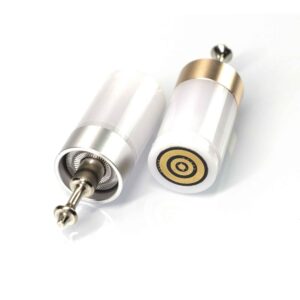
A light-capturing plug is a passive part. It is a short length of polycarbonate tube — around 50 mm is the common body length — with a diffusing face at the top, and it works because its base sits in the beam.
A self-lit plug is a small blade. It has its own LEDs and contacts that line up with the pins in the emitter, which means it is bound by the same protocol as the blade it replaces.
A long blade carries roughly 120 to 140 pixels over its length. A plug’s short strip runs far fewer, in a single segment.
That is where the incompatibility comes from. The two families depend on different parts of the hilt being live: one on the emitter’s light, the other on the emitter’s data pins.
| Light-capturing plug | Self-lit plug | |
|---|---|---|
| Electronics | None | Its own LEDs and contacts |
| How it lights | Captures the beam from the hilt’s LED | Driven by the hilt’s data pins |
| Colour behaviour | Follows whatever colour the hilt is set to | Can run ignition, colour change and effects |
| Works on an in-hilt LED saber | Yes | No — there are no data pins to drive it |
| Works on a strip blade saber | No — there is no in-hilt beam to capture | Yes |
| Body materials | Polycarbonate, or metal and acrylic on premium versions | Polycarbonate |
The failure is silent. A plug of the wrong family drops into the socket, fits perfectly, and simply does not light, which reads as a faulty plug rather than a mismatched one.
Socket Diameter, Depth and Fit
A blade plug is sized to the socket, not to the hilt. The number that matters is the blade bore diameter, which is 1 inch on most sabers and 7/8 inch on thinner ones, and a plug made for one will not fit the other.
There is no adapter between the two sizes, which is why the bore diameter should be confirmed before ordering rather than assumed from the hilt’s overall size.
Depth matters as much as diameter. A plug that is too long will not seat past the emitter’s internal features, and one that is too short leaves a gap above it that reads as an unfinished socket.
The commercial form is a short insert — around two inches, roughly 50 mm, is typical — with the light-emitting face at the top and the base sitting against the emitter’s internal shoulder.
The white diffuser disc at that face is usually 1 mm to 2 mm thick. A thicker disc trades brightness for evenness.
Where the fit is loose, the plug can rotate or rattle. Where it is tight, the emitter walls are usually the reason, and forcing it risks marking the bore.
Vented, Solid, and Why It Matters
A vented plug has openings through it and a solid plug does not. The difference only matters on sabers with sound, where the plug sits between the speaker and the outside world.
On a sound saber, the emitter end is not necessarily the speaker’s outlet — the speaker normally vents through the pommel. The plug matters where the design routes sound forward, or where the plug is being used as a speaker cover.
A solid plug in that position muffles the audio. This is a known enough problem that vented plugs exist specifically to solve it, and there are builds where the audio stays compressed until the centre of the plug is opened up.
Vented plugs also pass light, which lets an emitter with windows or vents in its sleeve glow — something a solid plug cannot do because it blocks the light path out of the hilt.
A passive plug needs the hilt to make light. A self-lit plug needs the hilt to send it data. Neither works on the other’s saber.
Why a Plug Never Looks Like a Blade
A plug cannot look like a shortened blade because a blade is lined with diffusion film and the plug is not. Without that lining, a plug shows weaker and less even output, and complex colours can visibly separate across its face.
A blade is not just a clear tube. It has a diffusing layer running its full length that scatters the source into an even column of light. On a 32-inch blade that lined run is around 810 mm of diffusion film; a plug has roughly 50 mm.
A plug is a few inches of material with a diffuser at the face. The light has almost no distance to spread over, so the result is a glow at the face rather than a column.
The diffusion layer in a plug is also usually a white disc rather than a lined tube, and its thickness affects how much light gets through and how evenly it is spread.
The colour separation is a practical consequence: with no lining to blend the channels, a plug lit by multiple emitters can show the individual colours rather than the mixed result the blade produces.
This is a design boundary, not a defect. A plug is judged on how it finishes an emitter and how it contains the light, not on reproducing a blade’s appearance.
Dueling, Storage and Transport
Blade plugs are display and storage parts, not dueling parts. They should come out before any contact use, and the blade goes back in instead.
The reason is structural. A plug is a short insert held by its fit in the socket, with no retention screw and no blade wall behind it.
An impact on a plug is taken entirely by the emitter bore. A blade, by contrast, is held by the retention screw and passes load up the blade tube rather than into the socket walls.
For storage and transport the plug earns its place. A hilt carried in a bag with the socket open is a hilt collecting whatever is in the bag.
Where the saber is being transported in a case, leaving the blade fitted occupies far more length than the hilt alone. The plug is what lets the saber be carried short without leaving the bore exposed.
Crossguard Quillons and the Vent Question
The crossguard quillons on a broken-crystal saber are vents rather than blades, and they are the clearest example in the lore of a saber deliberately letting energy out sideways. Their real-world counterparts are the vented emitter features that blade plugs have to work around.
In the crossguard design, the two side blades emerge from the same source as the main blade, split by an array of focusing crystals.
The side blades exist because the crystal cannot contain the full output. The vents give the excess somewhere to go, which is why they are described as balancing the weapon rather than extending its reach.
The same idea shows up in hardware as emitter windows, vents and slots. On a saber with those features, a solid plug blocks the light that would otherwise come through them, and a vented plug or a plug with its own light source is what keeps the emitter looking alive.
One practical note from the same territory: the flame-shaped and unstable-look blade covers sold as visual accessories are display parts. They are not built for contact and should be treated the same way as any other plug.
Frequently Asked Questions
Q1: What is a blade plug?
A: A blade plug is a short insert that goes into the blade socket when the blade is removed. It seals the opening against dust, contains the light from the emitter, and on some builds holds the LED module down. Most fit a 1-inch socket, with 7/8-inch versions for thinner hilts.
Q2: Do I need a blade plug?
A: If your saber has its LED in the hilt, a plug is standard practice for any powered use without a blade, because the emitter is live either way. If your blade carries its own LEDs, you do not need one for safety, but you need one with its own light source if you want the saber to glow with the blade removed.
Q3: Why won’t my blade plug light up?
A: The usual cause is a mismatch between the plug and the core. A passive plug needs an in-hilt LED to capture light from, and a self-lit plug needs data pins to drive it. Put a passive plug in a strip blade saber and it fits perfectly and stays dark, because there is no beam in the hilt to capture.
Q4: What size blade plug do I need?
A: Match the socket bore, which is 1 inch on most sabers and 7/8 inch on thinner ones. The two sizes do not interchange and there is no adapter between them. Depth matters as well — a plug that is too long will not seat past the emitter’s internal shoulder.
Q5: Can I leave a blade plug in during dueling?
A: No. A plug is held only by its fit, with no retention screw and no blade wall to spread the load, so an impact goes straight into the emitter bore. Remove the plug and fit a blade before any contact use.
Q6: What is a vented blade plug for?
A: A vented plug has openings through it so sound or light can pass. It matters on a sound saber where the plug sits in the audio path, because a solid plug in that position muffles the output. Vented plugs also let an emitter with windows or slots glow, which a solid plug blocks.
Q7: Why does a blade plug look dimmer than a blade?
A: Because a blade is lined with diffusion film running its full length and a plug is not. The film scatters the source into an even column; a plug has only a few inches and a face diffuser, so the light has almost no distance to spread. Complex colours can also separate across the plug face without that lining to blend them.
Q8: Can a blade plug break my saber?
A: Not by itself, but two things are worth watching. Forcing a tight plug can mark the emitter bore, and using a plug as a dueling part puts impact directly into the socket walls rather than up a blade. Fit it by feel and take it out before contact use.
Q9: What is the difference between a blade plug and a blade plug cover?
A: A blade plug seats inside the socket and caps it. Decorative covers in the shape of a flame or an unstable blade are display accessories only, and they are not built for contact. For dueling, treat them the same way as any other plug: take it out first.
Q10: Does a blade plug affect the saber’s sound?
A: Only if it sits in the audio path. Most sabers vent sound through the pommel at the opposite end, in which case the plug has no effect at all. Where the design routes sound forward, a solid plug will compress the output and a vented one will not.