
No — not in canon, and not in physics. The films themselves establish at least 4 materials and devices that resist a blade, and the real-world numbers behind an actual plasma blade put it 3 orders of magnitude beyond anything you can hold in one hand. The more useful surprise is what happens when a real saber meets something hard: it does not cut, it scuffs.
Most people asking this question mean one of two things, so it is worth separating them at the start.
The first is the fictional question: in the stories, is anything immune? The second is the practical one: what does the saber in my hands actually do to things?
The answers are different, and the second one is the one that costs money.
This page covers the 4 canon exceptions to the blade, what a lightsaber is supposed to be made of, the real physics figures for confining plasma at cutting temperature, what an actual saber does on contact, and where the “cuts through anything” idea came from.
What’s on This Page
- The 4 Canon Exceptions
- What a Blade Is Supposed to Be
- What the Physics Actually Requires
- What a Real Saber Does on Contact
- What Actually Breaks a Blade
- Where the Myth Comes From
- What to Expect From Yours
- Frequently Asked Questions
The 4 Canon Exceptions
Within the stories, a lightsaber cuts through most ordinary matter but is explicitly stopped by at least 4 things: beskar, cortosis, electrostaffs, and other lightsabers. None of those are edge cases invented by fans — each appears on screen.
The exceptions matter because they establish that the blade was never written as absolute.
Other blades are the first and most obvious case. Two lightsabers meet and stop, which means the containment field that shapes one blade is repelled by the other.
The second is a class of metal that resists plasma. The in-universe explanation is a property of the alloy itself rather than of thickness or angle, which is why it works as armour rather than as a shield.
The third is a weapon built to fight sabers specifically: a staff whose ends carry an energy field. The fourth is a mineral that disrupts the blade’s containment rather than merely resisting it.
| What stops it | How it works in canon | What it tells us |
|---|---|---|
| Another lightsaber | Field meets field and repels | The blade is a contained field, not a beam |
| Plasma-resistant alloy | Alloy’s own magnetic property repels the plasma field | Material can resist without thickness |
| Energy staff | A second contained field intercepts the blade | Only fields stop fields |
| Cortosis-type mineral | Disrupts the blade’s containment on contact | The containment is the weak point, not the plasma |
Read that third column as a single idea. Every canon exception works by interfering with the containment rather than by surviving the heat. That is a strong hint about what the blade actually is.
It also answers the original question cleanly: the blade cuts almost anything because almost nothing interferes with its containment. Where something does interfere, the blade stops.
What a Blade Is Supposed to Be
A lightsaber blade is not a laser. In canon it is super-heated plasma held in a sword shape by a containment field, energised by a crystal in the hilt. The blade’s length is set by where the field ends, not by how far the light travels.
This distinction is the source of most of the confusion, because the weapon is named after the wrong thing.
A laser is light, and light does not stop at a fixed distance from its source. Two light beams also pass through each other rather than clashing.
A plasma blade behaves differently in exactly the ways the films show. Plasma is matter, so it can be pushed, shaped, and repelled. Give it a boundary and it holds a shape; take the boundary away and it expands.
That is why the blade has a defined tip instead of fading out, and why two blades can press against each other.
The crystal in the hilt supplies the energy and, in canon, is what makes the field possible at a size a person can hold.
What the Physics Actually Requires
Real plasma confinement at cutting temperature is not a smaller version of what the films show. Melting through a thick steel door has been estimated at roughly 3 GW, equivalent to 3 nuclear plants. Other analyses put the crystal’s output near 63.6 MW for a blade at about 7,680 K.
The problem is not the temperature. It is holding the temperature in a shape, at arm’s length, without killing the person holding it.
Cutting most materials needs at least 4,000 K. Plasma can be confined at around 1,000,000 K in a magnetic bottle — but a fusion reactor’s magnetic bottle is the size of a building.
The numbers from published analyses scatter widely because each assumes a different cutting task, and that scatter is itself informative.
| Figure | Value | Assumption behind it |
|---|---|---|
| Power to cut a thick steel door | ~3 GW | The slow burn-through seen on screen |
| Blade power, alternative estimate | ~63.6 MW | Blade held at ~7,680 K |
| Intrinsic magnetic field | ~10.8 mT | Same analysis as above |
| Continuous power, 10 cm jet | ~40 kW | Jet at 10,000 °C |
| Minimum cutting temperature | ~4,000 K | Below this, most materials survive |
| Confinement temperatures | ~1,000,000 K | Where magnetic bottles are actually used |
Five orders of magnitude separate the most modest workable plasma jet from the cut the films actually show. That gap is the whole argument.
Two structural problems kill the design before the power budget does.
The first is that plasma cool enough to carry safely is too cool to cut, and plasma hot enough to cut cannot be carried. There is no overlap.
The second is containment geometry. A magnetic field has to close somewhere, which is why a real version would need field-generating rings at both the hilt and the tip — and a tip ring is a component floating in the thing doing the cutting.
Small variations in the field would deform the blade, contact with an external magnet would endanger the wielder, and the plasma would expand rather than hold a sword shape the moment confinement slipped.
What a Real Saber Does on Contact
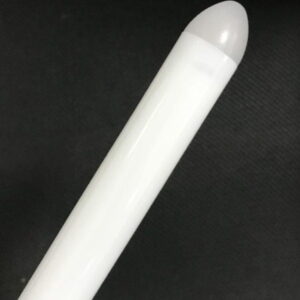
A saber you can buy does not cut anything. The blade is a polycarbonate tube around a light source, and against a hard surface it scuffs, marks and eventually cracks. Its failure mode is mechanical, not thermal.
This is the part that actually matters if you own one.
Nothing in a real saber is hot. The blade is lit by LEDs — either a single emitter in the hilt shining up a hollow tube, or a strip of addressable LEDs running the blade’s full length.
What the blade does to other objects is what any rigid plastic tube does. Hit a wall and it marks the wall and scuffs itself. Hit something harder than it and it takes the damage.
The glow is a strong illusion here, because a bright blade reads as dangerous. Against a surface, it behaves like a 1-inch plastic rod.
Contact is a choice, not a side effect. A saber kept for display will never see any of this; one used for sparring or choreography sees it every session, which is why blades are treated as consumables rather than as permanent parts.
What Actually Breaks a Blade
Three things do nearly all the damage: hard edge-on-edge strikes, contact with rigid surfaces, and impact at the tip. Wall thickness matters more than what lights the blade, and a glued tip is the component most likely to fail first.
Edge-on-edge is the strike that concentrates force into the smallest area of the blade wall, and it is the one to avoid even in controlled work.
Rigid surfaces have no give. Concrete, railings and ceilings can fail a blade that would have survived a clash with another blade.
The tip is the third and the most commonly overlooked. A thrust that lands on the tip puts the load along the blade’s weakest axis. A glued tip can break out and spill the blade’s internal lining, which is what diffuses the light evenly.
Inside a strip blade, the LEDs run the full length as a flexible strip. If a hard strike splits the blade, the strip is not repairable and the whole blade is replaced rather than a section of it.
A hollow blade has nothing inside to break, which makes it the cheaper thing to risk.
| Blade | Contact behaviour | Cost of a failure |
|---|---|---|
| 1″ hollow, 3 mm wall | Takes repeated controlled contact | Blade only; nothing inside to damage |
| 1″ strip, 3 mm wall | Handles choreography at agreed power | Whole blade, not a section |
| 7/8″, 2 mm wall | Flexes visibly on impact | Flex concentrates load; avoid for contact |
| Glued tip | Can break out under impact | Spills the internal lining |
| Screw-in tip | Stays put | None worth mentioning |
Set screws are the cheap failure that gets skipped. They work loose over a session, and a blade held by a screw that has backed out can leave the hilt mid-swing.
Where the Myth Comes From
The “cuts through anything” idea is a reasonable reading of the films rather than an error. On screen the blade defeats doors, vehicles and armour, and the exceptions are rare enough that they read as plot devices rather than as limits.
Three things reinforce it.
The first is screen time. A blade cutting through a thick door is one of the most memorable images in the series, and it happens slowly and with effort, which makes it feel like a demonstration of a limit rather than an exception to one.
The second is that the exceptions are all unusual. Armour that resists plasma, a staff built to fight sabers, a mineral that disrupts containment — each is introduced as a specific answer to a specific problem, so none of them reads as a general ceiling.
The third is the name. Calling it a lightsaber suggests light, and light has no upper bound on what it can pass through. The confusion is built into the word.
Physically, the real constraint runs the other way: the blade is not powerful enough to be unstoppable, it is too difficult to hold together to exist at all.
What to Expect From Yours
Realistically: no cutting, some scuffing, and a lifespan measured in sessions rather than years if you spar regularly. Set expectations by what the blade is made of, and treat blades as the consumable part of the hobby.
The romantic question and the practical one have almost nothing in common, which is worth saying plainly.
The blade you can hold is a plastic tube that lights up. It will not mark anything you could not mark with a stick.
What it does do is take contact well enough for choreography, provided the wall is thick and the strikes are controlled. That is the actual capability, and it is a real one.
Blades scuff before they fail, so a set used weekly wants rotating through the year rather than being kept until one breaks.
Buy the blade for how you will use the saber, keep a spare, and check the set screws before each session.
Frequently Asked Questions
Q1: Can a lightsaber cut through anything?
A: Not in canon, and not in physics. The films establish at least 4 things that stop a blade: another lightsaber, a plasma-resistant alloy, an energy staff built to fight sabers, and a mineral that disrupts the blade’s containment. All 4 work by interfering with containment rather than by surviving the heat. In real physics, a handheld plasma blade at cutting temperature is not possible with current technology.
Q2: Is a lightsaber a laser?
A: No, and the name is misleading. In canon it is super-heated plasma held in a sword shape by a containment field, energised by a crystal in the hilt. A true laser would not behave this way: light does not stop at a fixed blade length, and two light beams pass through each other rather than clashing. Plasma is matter, so it can be shaped and pushed, which is why the blade has a defined tip.
Q3: Why do two lightsabers clash instead of passing through each other?
A: Because each blade is a contained field rather than a beam of light, and fields repel each other. This is the single detail that rules out the laser explanation — two laser beams would cross without interacting. In canon, the containment field that shapes one blade is pushed back by the containment field of the other, which is what produces the clash.
Q4: How much power would a real lightsaber need?
A: Estimates vary with the task, which is itself informative. Melting through a thick steel door has been put at roughly 3 GW, equivalent to 3 nuclear plants. Another analysis puts the blade at about 63.6 MW, producing a temperature near 7,680 K and an intrinsic magnetic field of about 10.8 mT. A 10 cm plasma jet at 10,000 °C would need around 40 kW of continuous power.
Q5: Does a real lightsaber blade cut things?
A: No. A saber you can buy is a polycarbonate tube lit by LEDs, either a single emitter in the hilt shining up a hollow tube or a strip of addressable LEDs running the blade’s length. Nothing in it is hot. Against a hard surface it scuffs and marks, and its failure mode is mechanical rather than thermal. The glow makes it read as dangerous, but it behaves like a plastic rod.
Q6: What is the most damaging thing for a lightsaber blade?
A: A hard edge-on-edge strike against another blade, because it concentrates the force into the smallest possible area of the blade wall. Contact with rigid surfaces such as concrete, railings and ceilings is the second, since they have no give. Impact at the tip is the third and the most commonly overlooked, because a thrust lands the load along the blade’s weakest axis.
Q7: Can a lightsaber blade be repaired if it breaks?
A: It depends on the type. Inside a strip blade the LEDs run the full length as a flexible strip, so a hard strike that splits the blade means replacing the whole blade rather than a section of it, since the strip is not repairable. A hollow blade has nothing inside to break, which makes it the cheaper thing to risk and the better choice for heavy contact.
Q8: Why do blades need different wall thicknesses?
A: Because wall thickness decides how the blade behaves under load. A 1-inch blade with a 3 mm wall takes repeated controlled contact. A 7/8-inch blade with a 2 mm wall flexes visibly on impact, which concentrates the load and reads badly on camera. Wall thickness matters more than which electronics drive the blade, and it is the specification to check before buying.
Q9: How long does a lightsaber blade last?
A: It depends entirely on use. A saber kept for display will never see contact and the blade will outlast the electronics. One used for sparring or choreography sees contact every session, and blades scuff before they fail, so a set used weekly wants rotating through the year rather than being kept until one breaks. Treat blades as the consumable part of the hobby.
Q10: Do I need eye protection for lightsaber contact?
A: Yes, for both people, along with gloves if the hands come near the blade line. A blade that leaves the hilt on a swing is the risk worth guarding against, which is why the set screws should be checked before every session rather than once a season. Avoid hard edge-on-edge strikes, and keep clear of surfaces like ceilings, railings and walls that have no give.