
Choreography is not fighting slowly. It is a counted sequence in which both people know every move in advance, and the skill is making it read as a fight to someone who does not. That distinction decides everything else on this page: what to drill, which blade to use, and why distance works differently with a glowing blade than with a metal one.
Most beginners start by trying to duel and then trying to make it look good. That order does not work.
A choreographed exchange is built the other way round — the shape of the finished fight is decided first, then the moves are fitted into it.
There is also a problem specific to this weapon. Two people with metal swords calibrate distance by contact. Two people with sabers cannot, and the glowing blade actively lies about where its tip is.
This page covers the 12-point clock target system, how fights are counted into beats of 8–10 moves, the footwork rule that makes a sequence read, how to pick a blade that survives repetition, where contact actually causes damage, and how to build a sequence from nothing.
What’s on This Page
- Choreography vs Sparring
- The Beam Problem
- Target Zones: the Clock System
- Counting the Fight: Beats and Phrases
- Footwork: the Step That Makes It Read
- Choosing a Blade for Contact
- Safety and Failure Modes
- Building a Sequence From Scratch
- Frequently Asked Questions
Choreography vs Sparring
Sparring is competitive and unrehearsed; choreography is cooperative and fully scripted. In choreography both performers work toward the same visible result, and neither is trying to win. Every technique on this page assumes the scripted version.
The confusion between them causes most of the frustration beginners hit.
A sparring mindset makes you react, and reacting means improvising. Improvising means the sequence changes every time, which means it can never be smoothed, sped up, or made to look deliberate.
The cooperative version inverts the incentives. If your partner misses a parry, the correct response is to slow down and fix the parry — not to land the hit.
A landed hit in choreography is a mistake, and it is the signal to stop and rebuild the section that produced it.
The 4-fold difference between the two is easiest to see in what each one optimises for.
| Sparring | Choreography | |
|---|---|---|
| Purpose | Win the exchange | Reproduce a fixed result |
| Moves | Improvised | Scripted in advance |
| A landed hit | The goal | A mistake — stop and rebuild |
| Speed | As fast as possible | Added last, after the section is clean |
| Partner is | An opponent | A collaborator working toward the same shot |
If one of you is keeping score, nothing on the rest of this page will work.
The Beam Problem
A metal weapon tells you where it is through weight and contact. A saber does not. The blade is light, the hilt is where the mass is, and the glowing tube hides the true position of the tip. Distance has to be judged by eye and rehearsed to a measured value rather than felt.
Three separate effects stack up here, and all three are worse in a lightsaber than in a metal sword.
The first is mass distribution. A saber’s weight sits in the hilt and the battery, not along the blade. That makes the blade fast and easy to whip around, and it also means there is almost no inertia to tell you where the blade is when it stops.
The second is the visual overstatement. A bright tube on a dark background reads as longer and fatter than it is, because the glow spills past the physical edge. Two performers both aiming at what they see will consistently stop short of the distance they intended.
The third is the missing feedback. With metal weapons, a choreographed clash is confirmed by contact. With sabers, the clash has to be faked by stopping the blade at a set distance, and the only way to know you hit that distance is repetition.
This is why a clash that felt right on the day looks like two people swinging at air on video. The camera sees the gap; the performers never do.
The practical fix is to rehearse the stop distance as a fixed number rather than a feeling. A visible gap of about 5–10 cm between the two blades is a common starting point, and it should be measured once and then drilled until both of you hit it without looking.
A visible gap is not a flaw. On camera, blades that stop just short read as a clash; blades that actually touch and then bounce read as two props colliding.
Target Zones: the Clock System
Give every strike a name by imagining a 12-point clock face on your partner’s body, seen from your side. The hours mark where the blade tip is aimed, and both people call the same number for the same point. It gives a shared vocabulary for writing a sequence down.
The clock is drawn on the opponent, not on the room, and it stays attached as they turn.
Read from your own perspective: 12 is straight up, 3 is your left as you face them, 6 is low, 9 is your right.
Naming the target is what turns a move from “that swing” into a line you can write in a notebook and hand to someone else.
Attacks at 12 and 6 travel down the centreline and have no natural angle to slide off, which is why they read as the most dangerous-looking strikes.
Counting the Fight: Beats and Phrases
Stage fighting is written in beats — runs of 8 to 10 moves that end with the performers separating. A whole fight is a chain of beats, and within each beat one person is the attacker while the other responds. Roles can swap when they break apart.
The beat is the unit that makes a fight learnable, because it has a clear beginning and end.
Within a beat, one performer leads. The other answers every move.
When the beat ends, the two separate, and that break is where the roles can change hands. Numbering the attacks inside a beat is what makes rehearsal possible: instead of describing a swing, you say the number, and the number carries the target and the direction.
| Element | What it means | Why it matters in rehearsal |
|---|---|---|
| Beat | 8–10 moves, then a break | The chunk you rehearse and fix on its own |
| Lead | Whoever attacks for that beat | Fixed for the beat, so nobody improvises |
| Answer | The other performer’s response | Scripted, never reactive |
| Phrase | Several beats joined | Where pacing and escalation get built in |
| Break | The separation ending a beat | The only safe place to change roles |
Two counters are worth learning. One is the number of moves in the beat, so you can call “8” and both know where it ends. The other is the number of the strike itself, the target number from the 1–12 clock.
The escalation drill that builds this runs 1 step forward and 1 attack, 1 step back and 1 defence, repeating without resetting.
Start at 1 exchange, build to 10, then come back down to 1. If either performer is touched, the count restarts at 1.
Speed is the last thing added, not the first. A section that is fast and sloppy will not become clean by repeating it fast; it becomes clean at walking speed and then stays clean as the tempo rises.
Footwork: the Step That Makes It Read
The convention that does most of the work is simple: whoever attacks steps forward, whoever defends steps back. The blade alone does not carry a fight — without the feet, the same sequence reads as two people standing still and waving.
This rule is small and it is the difference between a fight and a flourish.
It also solves a practical problem: if the attacker advances and the defender retreats, the distance between you stays roughly constant across the whole sequence, so a section that works in one part of the room works everywhere.
Which foot goes forward sets what you can do next. The same lead foot on both people makes for a fast, long-reaching exchange; opposite lead feet keep the defensive option open on the counter.
Alternating the lead foot within a sequence, so that a strike is thrown from a left-forward stance and the next from a right-forward one, is how a run of moves avoids looking mechanical.
Half steps are enough. A step of about 30 cm is usually worth more visual motion than a full-length stride, because the camera reads the turn of the hips more than the travel.
Rehearsing at walking pace with the feet fully engaged is the instruction that experienced performers repeat most often, and the one beginners skip.
Choosing a Blade for Contact
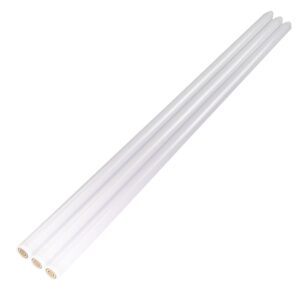
For choreography the blade’s wall thickness matters more than which electronics drive it. A 1-inch blade with a 3 mm wall takes controlled contact; a 7/8-inch blade with a 2 mm wall flexes visibly and should not be used for anything with impact.
Choreography is controlled, which puts it in a different category from full-force sparring.
Controlled contact means a hollow blade and a strip blade can both work — but the strip blade carries a consequence worth understanding before you commit.
Inside a strip blade, the LEDs run the full length as a flexible strip. If the blade takes a hard edge-on-edge strike and splits, the strip is not repairable, and the whole blade is replaced rather than the damaged section.
A hollow blade has nothing inside to break. That makes it the cheaper thing to hand to a beginner, and the cheaper thing to lose to a bad angle.
| Blade | Behaviour in contact | What it costs you |
|---|---|---|
| 1″ hollow, 3 mm wall | Takes repeated controlled contact | Heavier; diffuses light less evenly |
| 1″ strip, 3 mm wall | Handles choreography at agreed power | A split strip means a whole new blade |
| 7/8″, 2 mm wall | Flexes visibly on impact | Flex reads badly on camera; avoid for contact |
| Any blade, glued tip | Tip can break out under impact | Spills the blade’s internal lining |
| Any blade, screw-in tip | Tip stays put | None worth mentioning; the safer default |
Balance is the other practical difference. A strip blade carries its LEDs along its length and sits tip-heavier than a hollow one, which changes how it handles in a fast exchange and is worth a rehearsal to get used to.
Blades are consumables regardless of type. They scuff before they fail, so a set used weekly will want rotating through the year rather than being kept until one breaks.
Safety and Failure Modes
Most damage comes from three things: hard edge-on-edge strikes, contact with rigid surfaces, and impact at the tip. Eye protection and gloves are standard, and the blade’s set screws should be checked before every session — not once at the start of the season.
Edge-on-edge is the strike that concentrates force into the smallest possible area of the blade wall, and it is the one to avoid even in controlled work.
Rigid surfaces are the other common cause. Concrete, railings and ceilings have no give, so a blade that would survive a clash with another blade can fail against a wall.
The tip is the third. A thrust that lands on the tip puts the load along the blade’s weakest axis, and a glued tip is the part most likely to let go first.
Structural checks are cheap and they are the ones that get skipped. Set screws work loose over a session; a blade held by a screw that has backed out can leave the hilt on a swing.
Protection on the people matters as much as on the props: eye protection for both, and gloves if you are doing anything with the hands near the blade line.
The choreography-specific risk is the reverse of what people expect. The danger is not a hard hit — it is a habit of swinging through where a partner actually is, built up by weeks of rehearsal where they were always in the right place.
Building a Sequence From Scratch
Start with the end. Decide how the exchange finishes and what it looks like from the audience’s side, then work backwards to fill the beats. Sequences assembled forward from a cool first move tend to have nowhere to go.
Working backwards means each beat is chosen for what it sets up rather than for itself.
Begin with 1 beat: 8 moves, 1 attacker, a clear break at the end.
Rehearse that single beat at walking speed until both of you can perform it without speaking.
Then add the footwork rule to it — attacker forward, defender back — and rehearse again from scratch, because the sequence will feel different once the floor is moving underneath it.
Only after the beat is clean do you chain a second one onto it, and change the lead at the break.
Speed comes last, and only to the sections that are already clean at walking pace.
Two habits carry over from film practice. Never lose sight of your partner, and aim at the person rather than at their blade — a strike aimed at the blade looks like what it is, two props meeting. The same practice warns against overusing spins and flips, which read as impressive once and as filler when repeated.
Frequently Asked Questions
Q1: What is the difference between lightsaber choreography and sparring?
A: Sparring is competitive and unrehearsed; choreography is cooperative and fully scripted. In choreography both performers work toward the same visible result and neither is trying to win, so a landed hit is a mistake rather than a point. The drills differ accordingly: choreography is rehearsed at a fixed stop distance of roughly 5–10 cm and counted out loud, while sparring is improvised and scored.
Q2: How do you stop two lightsabers from actually hitting?
A: You rehearse a fixed stop distance and let the blades come close without touching. A visible gap of about 5–10 cm is a common starting point. Blades that stop just short read as a clash on camera, while blades that actually touch and bounce read as two props colliding. The trick is that both performers must judge the distance by eye, since a lightweight saber gives almost no tactile feedback.
Q3: Why does my choreography look wrong on camera when it felt fine?
A: Because the glow hides the gap. A bright blade reads as roughly 8 cm longer than the physical tube, so both performers aim at the glow and stop short of the distance they think they hit. Two performers each 8 cm short produce a visible 16 cm gap at the clash. The camera sees it while the performers never do, so filming a rehearsal is the only reliable way to find it.
Q4: What is the clock system in lightsaber choreography?
A: It is a way of naming targets by imagining a 12-point clock face drawn on your partner, seen from where you stand. 12 is straight up the centreline, 3 and 9 are the arm and shoulder lines, 1 and 11 are head height, and 5 and 7 are the hip and knee line. A parry is named the same way, so a defence covering target 3 is called 3P. It gives both performers the same word for the same point.
Q5: What is a beat in stage fighting?
A: A beat is a run of roughly 8 to 10 moves that ends with the performers separating. One person leads the beat and the other answers; roles can change during the break. Beats are the chunks you rehearse and fix individually, and a full fight is a chain of them. The count matters because it tells both performers exactly where the section ends.
Q6: Should both performers step forward at the same time?
A: No. The working convention is that whoever attacks steps forward and whoever defends steps back. That keeps the distance between the two roughly constant across a sequence, which means a section rehearsed in one part of the room works in another. It also stops the fight from reading as two people standing still and waving their blades.
Q7: Can you use a neopixel saber for choreography?
A: Yes, provided the blade is thick-walled and the contact is controlled. A 1-inch blade with a 3 mm wall takes choreography and light sparring well. The trade-off is what a failure costs: the LEDs run the full length of a strip blade as a flexible strip, so a hard edge-on-edge strike that splits the blade means replacing the whole blade rather than a section of it.
Q8: What blade thickness do I need for lightsaber dueling?
A: 3 mm, in a 1-inch diameter. A 7/8-inch blade with a 2 mm wall flexes visibly on impact, which reads badly on camera and concentrates the load. Wall thickness matters more than which electronics drive the blade, and it is the specification worth checking before buying a second blade for practice.
Q9: How fast should you rehearse a lightsaber fight?
A: At walking speed, with the footwork fully engaged, until the section is clean. Speed is the last thing added and never the thing that fixes a section, because a sequence rehearsed fast and sloppy does not become clean by more repetition at speed. The common escalation drill runs one attack forward and one defence back, building from 1 exchange to 10 and back down, restarting the count whenever either performer is touched.
Q10: Is it safe to practice lightsaber choreography at home?
A: It is, with basic precautions: eye protection for both performers, gloves if the hands come near the blade line, and a check of the blade’s set screws before every session rather than once a season. Avoid hard edge-on-edge strikes and keep clear of rigid surfaces like ceilings, railings and walls, which have no give. The choreography-specific risk is a habit of swinging through where a partner actually is, built up over weeks of rehearsal in which they were always in the right place.